Year in Review: 2025 Highlights and Achievements
Year in Review: As we bid farewell to 2025, it’s time to reflect on the remarkable milestones and achievements that have defined this year.
The Software Reliability Lab has had an extraordinary year filled with prestigious awards, groundbreaking research publications, major funding successes, and memorable team experiences. Here are the highlights from 2025.
🏆 Awards and Recognition
Two Amazon Research Awards
In June, we celebrated a major milestone: Alexandra Mendes and João F. Ferreira each received an Amazon Research Award in Automated Reasoning! Alexandra’s award focuses on “Overcoming Barriers to the Adoption of Verification-Aware Languages” with Dafny, while João’s proposal addresses “Polyglot Automated Program Repair for Infrastructure as Code.”
These awards recognize the cutting-edge research conducted at the Software Reliability Lab and provide crucial support for advancing automated reasoning and formal methods.
ACM SIGSOFT Distinguished Paper Award at ICSE 2025
Our lab started the year with a bang! Nuno Saavedra and João F. Ferreira, along with collaborators from UC San Diego, Imperial College London, and UMass, received the ACM SIGSOFT Distinguished Paper Award at ICSE 2025, the premier conference in software engineering, for the paper “Rango: Adaptive Retrieval-Augmented Proving for Automated Software Verification.”
Rango introduces an innovative automated proof synthesis tool that uses machine learning and large language models with retrieval augmentation techniques. Tested on the newly created CoqStoq dataset of over 2,200 open-source Coq projects, Rango successfully synthesized proofs for 32% of theorems, representing a 29% improvement over previous state-of-the-art tools.
Most Cited Papers from ICSE and ASE According to Scholar Metrics
Another highlight this year came from recognizing the lasting impact of our earlier work on smart contract analysis. According to the 2025 Scholar Metrics, the paper “Empirical Review of Automated Analysis Tools on 47,587 Ethereum Smart Contracts” (T. Durieux, J.F. Ferreira, R. Abreu, P. Cruz – ICSE 2020) is the most cited paper from ICSE, while the companion paper “SmartBugs: A Framework to Analyze Solidity Smart Contracts” (J.F. Ferreira, P. Cruz, T. Durieux, R. Abreu – ASE 2020) ranks as the fourth most cited paper from ASE!
What started as a simple need to create a proper dataset for evaluating smart contracts evolved into SmartBugs, a framework that has been adopted in CI pipelines, audits, and teaching worldwide (including at TU Wien). The tool has grown far beyond its initial prototype, with the community continuously extending it with new tools and features, leading to SmartBugs 2.0 featured in an Empirical Software Engineering 2024 paper.
💰 Major Funding Success
InfraGov: New Project on IT Infrastructure Reliability
In March, João F. Ferreira and Alexandra Mendes secured funding for the InfraGov project, addressing critical challenges in the reliability and security of Infrastructure as Code (IaC) used in Public Administration.
InfraGov is developing a technology-agnostic framework for automated detection and repair of errors and vulnerabilities in IaC, leveraging cutting-edge advances in generative AI. The project is being developed in close collaboration with key Portuguese government partners: AMA, IGFEJ, and ESPAP. This ensures real-world impact across Portuguese public infrastructure.
SafeIaC: Building Technology-Agnostic Solutions for IaC
In July, we launched SafeIaC, an ambitious research project focused on building the first technology-agnostic solution for reliable analysis and automated repair of Infrastructure as Code with formal correctness guarantees.
SafeIaC aims to revolutionize how we ensure the reliability and security of DevOps systems by combining Artificial Intelligence and Formal Methods. The project builds on our lab’s expertise in Infrastructure as Code reliability, including our GLITCH and InfraFix tools, and extends this work to provide stronger guarantees about the correctness of automated repairs.
📚 Outstanding Research Publications
2025 was a great year for publications, with several papers accepted at top-tier conferences and journals! Some examples are:
Rango: Adaptive Retrieval-Augmented Proving for Automated Software Verification - ICSE 2025 (CORE A*, ACM SIGSOFT Distinguished Paper Award)
InfraFix: Technology-Agnostic Repair of Infrastructure as Code - ISSTA 2025 Tool Demonstrations Track (CORE A)
Do Experts Agree About Smelly Infrastructure? - IEEE Transactions on Software Engineering (Q1 journal)
Contract Usage and Evolution in Android Mobile Applications - ECOOP 2025 (CORE A)
What Challenges do Developers Face when using Verification-Aware Languages? - ISSRE 2025 (CORE A)
Specification-Guided Repair of Arithmetic Errors in Dafny Programs using LLMs - SEFM 2025 (CORE B)
Can Language Models Help Students Prove Software Correctness? An Experimental Study with Dafny - SEFM 2025 (CORE B)
Are Users More Willing to Use Formally Verified Password Managers? - SEFM 2025 (CORE B)
Teachers’ Perspective on Software Testing Education - ACM Transactions on Computing Education (Q1 journal)
🌍 International Collaboration and Recognition
Dagstuhl Seminar on Specification Engineering
Alexandra Mendes was invited to participate in the prestigious Dagstuhl Seminar 25392 on “Specification Engineering: Foundations for the Future of Software Development” in September. The seminar brought together leading researchers and practitioners to discuss recent advancements, challenges, and future directions in specification engineering, formal methods, and requirements engineering.
This invitation highlights our lab’s international reputation and commitment to advancing the field of software engineering.
🎉 Team Building and Lab Culture
Building a strong research community goes beyond publications and projects: it’s about the connections we build and the moments we share. Throughout 2025, our lab met regularly for lunches and dinners, fostering collaboration and camaraderie. Here we highlight two special social events that brought our team together in memorable ways.
Barracuda Submarine Visit
In October, the lab embarked on a unique team-building experience: a visit to Portugal’s historic S164 NRP Barracuda submarine, now a museum ship. The visit provided our team with fascinating insights into naval history and submarine engineering, followed by a tour of the historic Fragata D. Fernando II e Glória and a delicious Portuguese lunch.
Special thanks to Bruno Lourenço for guiding us through the submarine and sharing his extensive knowledge!

Online Christmas Social
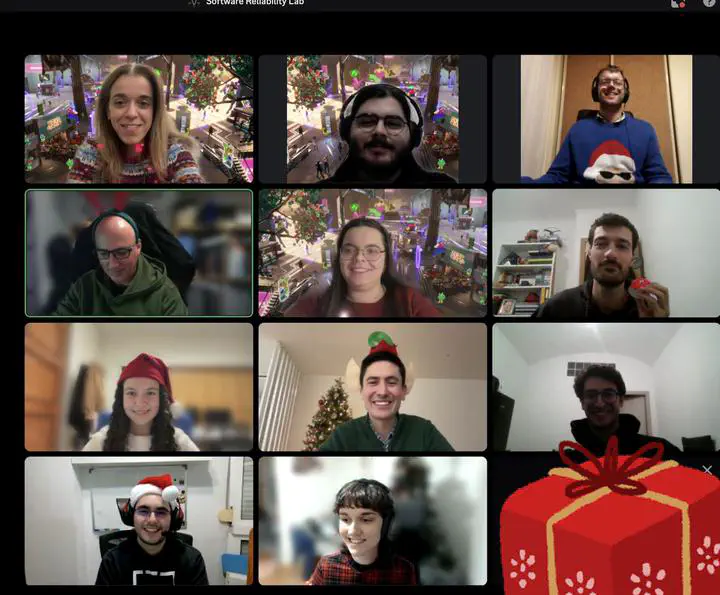
As the year drew to a close, the Software Reliability Lab came together for an online Christmas social that brought joy and friendly competition to our distributed team! 🎄
With team members spread across the country and around the world, we gathered on Discord, our virtual headquarters, for an exciting quiz night featuring three teams competing across four rounds of questions. The event was filled with laughter, teamwork, and plenty of competitive spirit as teams competed in a spirit of friendly rivalry.
A huge thank you to Carolina Carreira and Álvaro Silva for organizing such a fantastic event! It was the perfect way to celebrate the season and strengthen the bonds within our amazing research group!
🚀 From Research to Impact: Codeset.ai
Bridging the gap between academic research and real-world impact, our PhD student Nuno Saavedra and lab alumnus André Silva co-founded codeset.ai, a startup focused on transforming how developers work with code. This venture demonstrates how cutting-edge research in software reliability and automated reasoning can translate into practical tools that benefit the broader software development community.
We’re excited to see how Nuno and André’s entrepreneurial journey unfolds and look forward to the impact codeset.ai will have on the industry!
Looking Ahead to 2026
As we close 2025, we’re excited about the opportunities ahead. With new funding from Amazon, and the InfraGov and SafeIaC projects, we’re expanding our research team and continuing to push the boundaries of software reliability, automated reasoning, and formal methods.
We’re also ending the year with exciting news for 2026: Alexandra Mendes and Isabel Amaral had their paper “MutDafny: A Mutation-Based Approach to Assess Dafny Specifications” accepted at ICSE 2026 (CORE A*)! The preprint is available on arXiv.
If you’re interested in research positions on automated reasoning, program repair, or formal verification, get in touch! We have several positions available.
Thank you to all our collaborators, funding agencies, and partners who made 2025 such a successful year. Here’s to an even more impactful 2026!
Happy New Year from the Software Reliability Lab! 🎊